
What is a Prenuptial Agreement? Everything Couples Should Know
July 13, 2026
Misdemeanor vs. Felony: Understanding the Long-Term Consequences
August 18, 2026
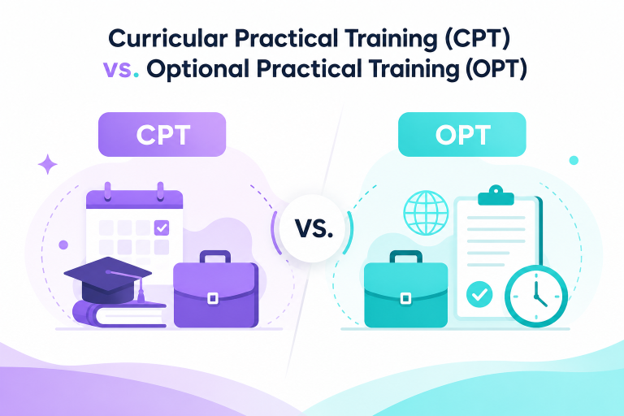
If you're an international student on an F-1 visa, you've probably run into a big question: CPT or OPT, and which one actually fits your situation?
It's a common source of confusion, since both let you work legally in the U.S., but differ significantly in eligibility rules, application timelines, and long-term effects on your career.
This guide gives you a clear CPT vs. OPT comparison, so you can understand their key differences, eligibility rules, and choose the right one for your situation.
Since status errors can affect your future work authorization, many students consult student visa attorneys before applying to ensure their application is accurate and complies with immigration requirements.
What is CPT and OPT?
Curricular Practical Training (CPT) is work that is required for your degree or earns academic credit. Your Designated School Official (DSO) approves it, so you do not need separate approval from USCIS. Because your school handles the process, approval is usually faster as long as you first meet the F1 student visa requirements. Also, you can only use CPT while you are actively enrolled, and it ends when you complete your program.
Optional Practical Training (OPT) is temporary work authorization for jobs related to your major. Unlike CPT, USCIS approves OPT instead of your school. This gives you more flexibility because you can use it before or after graduation. Standard OPT lasts 12 months. If you have a qualifying STEM degree, you can also apply for a 24-month extension.
Many graduates take advantage of this extension. In 2024, ICE approved 95,384 STEM OPT applications, according to the SEVP report. This shows how important it is for students in technical fields looking for more U.S. work experience. Once your OPT is approved, your employer handles your employment paperwork and tax forms just like they would for any other U.S. worker.
CPT vs OPT: Key Differences
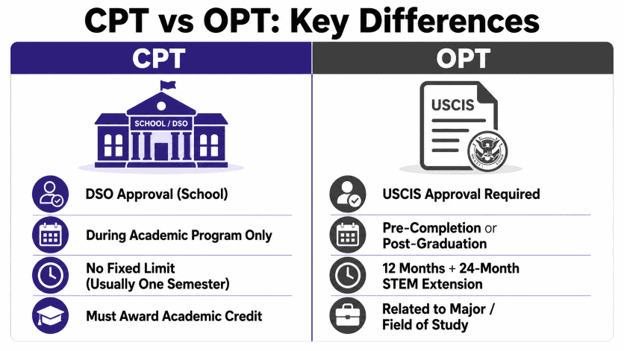
In the OPT vs CPT comparison, the biggest difference lies in their timing and who approves them. Besides these distinctions, here are the key factors that set them apart.
Approval

Your Designated School Official (DSO) authorizes CPT through your school's international office. For OPT, you must submit an application to USCIS and wait for approval before you can begin working. Also, both have similar approval rates. According to ICE's 2024 SEVP report, 194,554 students received OPT while 130,586 were approved for CPT in 2024.
When You Can Use It
CPT work authorization is only available while you are enrolled in your academic program. OPT is available as pre-completion OPT during your studies or post-completion OPT after you graduate.
How Long It Lasts
Federal regulations do not set a maximum length for CPT, but schools usually limit it to a semester or the length of a required course. Standard OPT provides up to 12 months of work authorization. Eligible STEM graduates can apply for an additional 24-month STEM OPT extension.
Connection to Your Studies

Another difference between CPT and OPT is that CPT must be part of your academic program, such as a required internship or a course that awards academic credit. OPT only needs to be directly related to your major or field of study.
Effect on Future OPT Eligibility
Using 12 months or more of full-time CPT makes you ineligible for post-completion OPT. If you plan to use both programs, it is important to track your full-time CPT carefully so you do not lose your eligibility for OPT.
OPT vs CPT Visa
Many international students think that CPT and OPT are tied to a separate visa category. However, they are both simply temporary work authorizations available under your F-1 student visa and are connected to your academic program.
CPT and OPT Eligibility Requirements
The eligibility rules for both CPT and OPT and their core differences are described below.
CPT Requirements
To qualify for CPT, you must meet these requirements:
- Complete one full academic year of study, unless your graduate program requires an internship from the beginning.
- Accept a job or internship that is directly related to your major.
- Enroll in a course that requires or awards academic credit for the work experience.
- Receive approval from your Designated School Official (DSO) before starting each new CPT job or internship.
Many colleges and universities also work with local employers to offer internship opportunities. These partnerships help students find positions that meet both academic requirements and career goals.
OPT Requirements
To qualify for OPT, you must meet these requirements:
- Valid F1 status and completion of one full academic year.
- Choose a job that is directly related to your field of study.
- File Form I-765 with U.S. Citizenship and Immigration Services (USCIS).
- Apply within the required filing period. You can apply up to 90 days before completing your program for pre-completion OPT. For post-completion OPT, you must apply within the official filing window after finishing your degree.
For example, a computer science student may apply for post-completion OPT after graduation to begin working for a software company. A marketing student may use pre-completion OPT during the final semester to gain part-time work experience while continuing classes.
Moreover, F-1 students who bring dependents on an F2 visa should also plan their work authorization timeline around their family's status.
Pre-Completion OPT vs CPT
Pre-completion OPT works differently from CPT. It allows you to work part-time while school is in session and full-time during official school breaks.
One important difference is that any time you use for pre-completion OPT reduces your total 12 months of OPT eligibility. CPT does not reduce your OPT time unless you complete 12 months or more of full-time CPT.
Any income you earn during pre-completion OPT is generally subject to the same U.S. tax rules that apply to other paid jobs.
Which Option Should You Choose?
The right choice depends on where you are in your education and what you want to do next.
- Choose CPT if: you need to complete an internship, co-op, or other work experience that is required for your degree or directly related to your coursework while you are still enrolled in school.
- Choose OPT if: you want to gain work experience after graduation. It is the better option if you plan to start a full-time job and want more flexibility. If you earn a qualifying STEM degree, you may also be eligible for a 24-month STEM OPT extension.
- Use both CPT and OPT if: your academic and career timelines allow it. For example, you might complete a CPT internship during your junior year to meet a degree requirement. After graduation, you could switch to post-completion OPT and later apply for the STEM OPT extension if you qualify.
No matter which option you choose, it's best to discuss your situation with a professional immigration lawyer. Expert advice can help you choose the right path based on your current situation and your career goals.
Final Words
When it comes to CPT vs. OPT, there is no one-size-fits-all answer. The right option depends on where you are in your academic program, your school requirements, and your long-term career goals. Once you start working, it is also important to understand how U.S. taxes work because they affect your paycheck from your first day on the job.
At Toure-Hernandez & Associates, P. C., we help international students and recent graduates stay compliant with F-1 visa requirements. We also assist with CPT and OPT applications, status changes, RFEs, and other issues that could affect your work authorization. Contact our team today to schedule a consultation and protect your status throughout the process.