
What is an EB-3 Visa? A Simple Guide for First-Time Applicants
June 24, 2026
CPT vs. OPT: Which Option Should You Choose?
July 27, 2026
What is a Prenuptial Agreement? Everything Couples Should Know
Prenups used to carry a stigma, as if signing one meant you didn’t trust your future spouse. That thinking has changed. These are now a normal step for couples planning their financial future together.
But what is a prenuptial agreement, really?
It’s simply a written contract that couples sign before marriage to outline how their finances will work, both during the marriage and if it ever ends.
To help couples make an informed decision, this article offers a complete guide on a prenuptial agreement, including what it covers, how the process works, and its key benefits.
Because the terms of a prenup can have a lasting effect on both spouses’ financial rights, it’s best to get a marital asset division attorney involved in the process. They can help you prepare an agreement that is legally enforceable and best suited to your situation.
What is a Prenuptial Agreement in Marriage?
A prenuptial agreement is a written legal contract that two people sign before they get married. It explains how they will divide their property, debts, and other financial responsibilities if their marriage ends through divorce or the death of a spouse. A prenup agreement is also called a premarital agreement or simply a prenup.
That said, prenuptials are no longer used only by wealthy couples. They have become a common part of wedding planning for many people. According to a 2026 Harris Poll conducted for Bloomberg, 53% of engaged or married Americans under the age of 45 have signed a prenuptial agreement in 2026.
What Does a Prenup Cover?
The prenup meaning goes beyond just dividing your assets. It can help you handle nearly any financial matter tied to the marriage. Below are the common items it covers:
- Separate property owned before the marriage. This includes assets such as a home, retirement accounts, investments, or an inheritance that one person owned before getting married.
- Property and debt acquired during the marriage. The agreement can explain how jointly acquired assets and shared debts will be divided if the couple divorces.
- Spousal support. A prenup can set the terms for future spousal support, including limiting the amount or allowing both spouses to waive it, if permitted by state law.
- Business ownership. A prenup can protect a business owned by one spouse by stating that it will remain that spouse’s separate property. For example, if one partner owns a small bakery before the marriage, the agreement can specify that the business will stay with that partner if the marriage ends.
- Existing debt. A prenup can state that each spouse will remain responsible for debts they brought into the marriage, such as student loans or credit card balances.

How Does a Prenup Work?
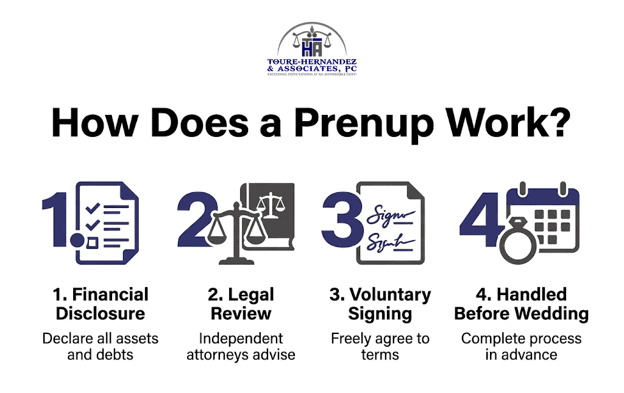
A prenuptial or marriage agreement follows a straightforward process. Before the wedding, both partners share complete and accurate information about their finances, discuss and agree on the terms, and sign a written agreement in front of a notary public.
The process usually includes these steps:
Step 1. Financial Disclosure:
Each partner provides a complete list of assets, debts, income, and other financial obligations.
Step 2. Legal Review:
The couple discusses the terms and makes any needed changes until they both agree. At this stage, each person should have their own family law attorney review the agreement and explain their legal rights before they sign.
Step 3. Voluntary Signing:
The final agreement is put in writing and signed voluntarily by both partners. Neither person should be pressured, threatened, or forced to sign. If a court finds that someone signed under duress, the agreement may not be enforceable.
Step 4. Wedding Deadline:
The prenuptial agreement must be signed before the marriage takes place. Once the couple is married, they cannot create this agreement. Instead, they must use a postnuptial agreement.
Key Benefits of a Prenup in Marriage
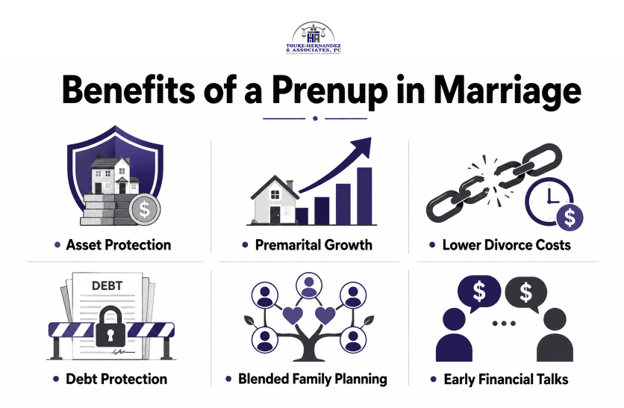
So, what does a prenup do that makes it so convenient? Its biggest benefit in marriage is that it settles financial questions in advance, so there’s less room for uncertainty or conflict later. Beyond that general reassurance, a prenup offers several specific benefits:
- Asset Protection: It protects property, savings, investments, businesses, and other assets that either spouse owned before getting married.
- Premarital Growth: It protects income and financial growth from premarital assets when allowed under state law and the terms of the agreement.
- Lower Divorce Costs: It can reduce the time, stress, and legal costs of a divorce because many financial issues have already been decided.
- Debt Protection: It prevents one spouse from becoming responsible for the other spouse’s debts that were incurred before the marriage, when permitted by law.
- Blended Family Planning: It helps couples with blended families or second marriages create clear financial plans, including how assets will be managed and preserved for children from previous relationships.
- Early Financial Talks: It encourages honest conversations about income, debts, financial goals, and expectations before marriage, helping both spouses start the relationship with a clear understanding of their finances.
What a Prenup Cannot Include
While this agreement before marriage decides most marital financial matters, it cannot decide issues involving children. It cannot determine child custody or child support because those decisions are made by a court during a divorce. The court decides these matters based on the child’s best interests at that time, not on an agreement the parents signed before they were married.
A court can also reject parts of a prenuptial agreement if they are unfair. If a judge finds that a provision is extremely one-sided or unreasonable, the court may refuse to enforce it, even if both spouses agreed to it when they signed the agreement.
A prenup is designed to clarify financial rights and responsibilities between spouses. However, it cannot take away a court’s responsibility to protect a child’s well-being or enforce unfair terms.
Is a Prenup Right for You?
A prenuptial agreement is not just for wealthy couples. It can benefit any couple who wants clear financial expectations before getting married.
If you are struggling to decide whether signing a prenup is right for you, you can ask yourself a few questions to figure out if it fits your situation.
- Are you bringing a business, property, or significant savings into the marriage?
- Do you have children from a prior relationship whose inheritance you want to protect?
- Is there a noticeable income gap between you and your partner?
If you answered yes to any of these, a prenup can be a great option. In fact, more and more couples are taking this kind of financial planning seriously.
According to Bowling Green State University’s National Center for Family & Marriage Research, the marriage-to-divorce ratio reached 2.42 in 2024, the highest point since 2008. This suggests couples are marrying more thoughtfully and planning ahead financially through measures such as nuptial agreements.
Final Words
Understanding what a prenuptial agreement is can help couples enter marriage with complete clarity instead of unanswered questions. Because every couple has different financial goals, each agreement should be tailored to their specific needs and situation. Working with a legal professional can help you plan and divide assets more effectively.
At Toure-Hernandez & Associates, P.C., we help couples through every stage of marriage planning and divorce through personalized legal help. Our dedicated team of attorneys can work with you to identify and divide marital property fairly and protect your assets. Get in touch today to prepare a customized agreement that protects both spouses’ interests and is legally enforceable when needed.