
CPT vs. OPT: Which Option Should You Choose?
July 27, 2026
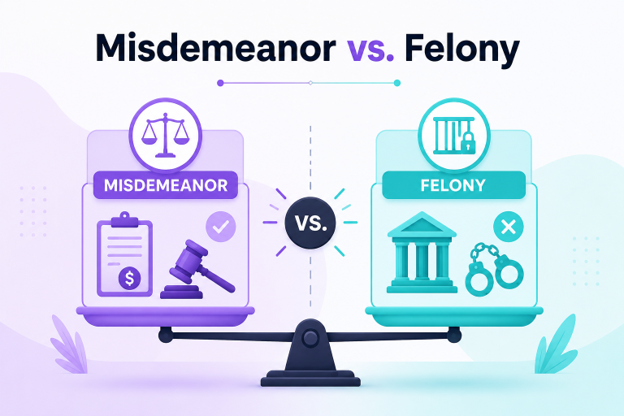
The core difference between misdemeanor and felony lies in the crime’s severity and punishment. Misdemeanors are lesser offenses punishable by fines or up to a year in local jail. Meanwhile, felonies are serious crimes carrying more than a year in state or federal prison. Both create a criminal record, which can affect your job prospects and your civil rights in the long-term.
This article offers a complete breakdown of misdemeanor vs felony, including their key differences, consequences, and examples. Because the classification of a charge can shift the outcome dramatically, speaking with certified criminal defense attorneys early can make a huge difference in how your case unfolds.
What is a Misdemeanor vs Felony?
A misdemeanor is a criminal offense less severe than a felony. Depending on the law and the specific offense, the penalties may include a fine, probation, community service, or up to one year in a local or county jail. Misdemeanors can include offenses such as low-level theft, disorderly conduct, or a minor physical altercation.
A felony is a more serious criminal offense compared to a misdemeanor. A felony conviction can result in more than one year in state or federal prison, higher fines, and other long-term legal consequences. Examples include armed robbery, aggravated assault that causes serious bodily injury, and drug trafficking.
So, is a felony worse than a misdemeanor? Yes. Felony crimes are more serious than misdemeanors because they can involve greater harm, higher financial losses, or repeated criminal behavior. They also carry more severe penalties and longer-lasting legal consequences. That’s why it’s worth talking to a felony attorney who can walk you through your options before you decide how to move forward.

What is the Difference Between a Felony and a Misdemeanor
When comparing a misdemeanor vs a felony, the main difference is in the seriousness of the offense and the penalties that can follow a conviction. Felonies carry longer prison sentences and higher fines, while misdemeanors result in shorter jail sentences and lower fines.
Classification and Severity
Courts classify misdemeanor crimes as less serious offenses and felonies as more serious crimes. Felonies involve significant physical harm, substantial property damage, or a high-value loss. However, the specific classification depends on the law that applies to the offense.
Also, if you’re wondering how many misdemeanors equal a felony, it’s best to know that repeated misdemeanors do not automatically become a felony. However, some states have repeat-offender laws that can increase the charge or penalty when a person has prior convictions for certain offenses.
Sentencing and Penalties
Misdemeanor charges carry shorter jail sentences, with a maximum of less than one year in a local or county jail. They can also result in fines, probation, community service, or other court-ordered minor penalties.
In contrast, what are the felony charges? Depending on the offense and applicable law, a felony charge can include a prison sentence of one year or more, along with substantial fines. The exact sentence depends on the type of felony, the defendant’s criminal history, and the sentencing laws in the jurisdiction.
Even a shorter sentence can lead to long-lasting consequences on your record. A misdemeanor attorney can review the specifics of your charge and help you understand what’s really at stake.
Federal Versus State Rules
Federal statutes establish the classification of offenses and the maximum penalties that apply to them. However, state laws use their own classification systems and sentencing rules. As a result, the same conduct may be classified differently under federal and state law. The applicable jurisdiction, statute, and circumstances of the offense determine whether a charge is treated as a misdemeanor or felony.

Long-Term Consequences of Felony vs Misdemeanor
A criminal conviction can affect your life long after you complete your sentence. The National Inventory of Collateral Consequences of Conviction currently tracks more than 40,000 state and federal consequences linked to criminal convictions. Here are some common ones.
Employment and Professional Licensing
Both felony and misdemeanor convictions can appear on background checks and affect your ability to get a job or professional license. The key difference between the two is the scope and duration of these restrictions. A felony conviction can create barriers in more areas of life and may continue to affect you for many years after you complete your sentence.
Depending on the offense and state law, a felony conviction can prevent you from obtaining:
- Professional licenses (nursing, real estate, law, and more)
- Government and federal jobs
- Firearm ownership rights
- Certain housing and loan applications
Sentencing Outcomes And Records
Compared to a misdemeanor, a felony can result in more severe sentencing depending on the severity of the crime. According to the U.S. Sentencing Commission’s 2024 Annual Report, felony offenses accounted for 97% of federally sentenced cases in fiscal year 2024. Courts imposed prison-only sentences in 89% of those cases.
These figures show that federal felony cases frequently result in incarceration and create a criminal record that can affect a person’s future employment and other opportunities.
Civil Rights And Housing
A felony conviction can also affect certain civil rights and housing opportunities. State laws vary, but most commonly a felony conviction can:
- Suspend or restrict voting rights
- Prevent someone from serving on a jury
- Create barriers to public housing and certain rental opportunities.
In contrast, misdemeanor convictions result in fewer restrictions on civil rights. In many cases, people convicted of misdemeanors retain their voting rights and remain eligible for opportunities that may be restricted after a felony conviction.

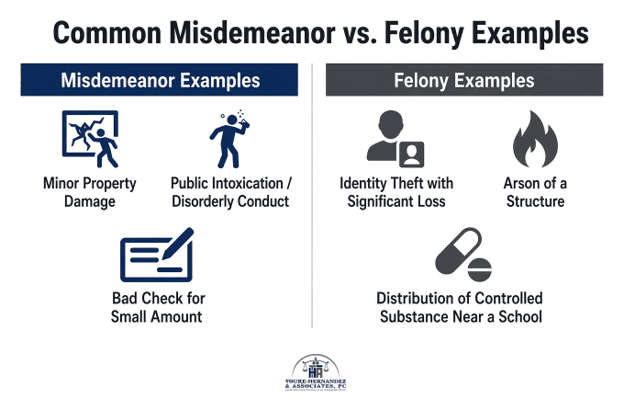
Common Misdemeanor vs. Felony Examples
Let’s look at some common examples to see how misdemeanors and felonies differ in practice.
Misdemeanor Examples:
Below are common misdemeanor cases.
- Vandalism causing minor property damage: If the damage is relatively minor, the person may face fines, restitution, or community service.
- Public intoxication or disorderly conduct: Depending on the state and the circumstances, the penalties may include a fine or a short jail sentence.
- Writing a bad check for a small amount: Knowingly writing a check without enough money in the account is a misdemeanor if the amount is below the state’s felony threshold.
Felony Examples:
Now, what is considered a felony? Here are common examples.
- Identity theft involving stolen financial accounts: Stealing or using someone else’s financial account information resulting in significant financial losses or involving multiple victims.
- Arson of a structure: Intentionally setting fire to a building causing extensive property damage and putting people’s lives at risk.
- Distribution of a controlled substance near a school: Selling or distributing a controlled substance within a legally protected area around a school. In states with school zone laws, the offense may also carry enhanced penalties.
Ultimately, several factors can affect how an offense is charged and punished. These include the state laws, financial loss, the location of the offense, the defendant’s intent, and their prior criminal record.
Final Words
The difference between misdemeanor vs felony goes beyond the length of your sentence. A conviction can affect your criminal record, career opportunities, and civil rights long after your case ends. Because these consequences can follow you for years, having an experienced attorney evaluate your specific charge early can make a meaningful difference in the outcome.
At Toure-Hernandez & Associates, P. C., we offer personalized defense strategies for both misdemeanor and felony charges. We fight to reduce penalties, challenge weak and unreliable evidence, and protect your record at every stage of the process. Contact our team today for a confidential consultation and take the first step toward protecting your future.