Complete Guide to the F2 Visa for Dependents in 2026
May 25, 2026
What is an EB-3 Visa? A Simple Guide for First-Time Applicants
June 24, 2026
At the end of 2025, nearly 12 million USA immigration cases were pending, according to USCIS data.
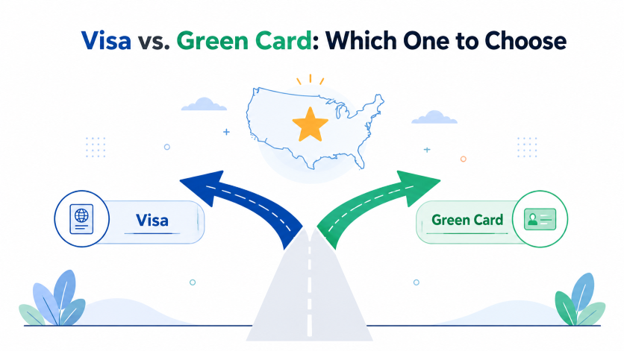
As more people seek legal ways to live, work, study, or join family members in the US, it is important to understand the difference between a visa and a green card. Both options allow entry into the U.S., but they differ in purpose, length of stay, and the rights they provide.
This article provides a detailed green card vs visa comparison to help individuals and families make informed immigration decisions.
For more specific guidance, you can also work with a USA Immigration Service that can help you evaluate the most suitable pathway for your situation.
Visa and Green Card – Exploring the Basics
A visa is a temporary authorization, typically a stamp or sticker in your passport, that lets you enter the U.S. for a specific reason and for a limited time. In total, there are over 185 visa categories issued by the U.S. Department of State, which can be of two main types.
- Non-immigrant visas are for temporary stays like studying, working, or tourism.
- Immigrant visas, on the other hand, are for people who have already been approved to become permanent residents.
A green card or Form I-551, is your proof of permanent residency in the United States. It allows you to live and work there without a fixed expiration tied to your stay purpose.
Immigrant Visa vs Green Card
It’s also important to know that an immigrant visa is not the same as a green card. An immigrant visa gets you to the U.S. as an approved permanent resident, while a green card is the official proof of that permanent residency status once you arrive.
Green Card vs Visa: What’s the Difference?
Choosing between a work visa and a green card involves more than deciding how long you can stay in the United States. These two options differ in important ways that affect your job options, family situation, and long-term legal status.
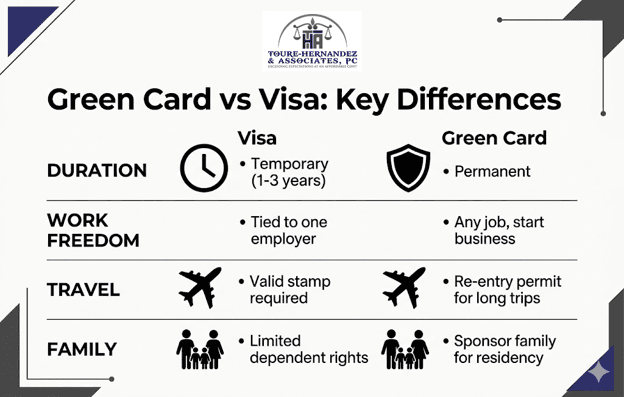
Below is a detailed breakdown of their key differences.
Duration and Status
Most temporary work visas, such as the H-1B, L-1, and O-1, are approved for a specific period, usually one to three years. Before the visa expires, you must apply for an extension if you want to continue living and working in the United States. The consequences of overstaying a visa can range from re-entry bars to removal proceedings.
A green card provides permanent resident status. Once your application is approved, you can live and work in the US indefinitely as long as you continue to meet the requirements for permanent residents. Although the physical green card must usually be renewed every 10 years, renewing the card does not affect your permanent resident status.
Work and Employer Freedom
The work visa vs green card distinction is another important factor to consider before moving to the US. Most work visas are tied to a specific employer. If your employment ends, your ability to remain in the US may be affected, and you may need to find another qualifying employer or change your immigration status.
Green card holders are not limited to a specific employer. They can change jobs, move to a different industry, work for multiple employers, or start their own business without applying for additional work authorization.
Travel and Re-entry
Before traveling outside the United States, visa holders should make sure the visa stamp in their passport is still valid. To return, you must have both a valid immigration status and a valid visa stamp.
In contrast, a valid green card usually allows you to return to the United States after a trip abroad that lasts less than six months. For stays longer than six months, you will need a Re-entry Permit or Form I-131, which lets you remain outside the US for up to two years. However, long absences can still lead to intense scrutiny from the USCIS.
Family Inclusion
Many employment-based visas allow a spouse and unmarried dependent children under age 21 to accompany the primary visa holder to the US. However, family members in a dependent visa status usually have limited work authorization.
Green card holders can sponsor certain family members for permanent residence. However, most family-sponsored categories have annual limits on the number of green cards available. As a result, applicants may face waiting periods ranging from several years to much longer.
Which Path Is Right for Your Situation?
The right choice between a visa and a green card depends on your immediate goals, how long you plan to stay, your family situation, and your career plans.

Let’s look at the factors that determine the right path.
Temporary Stay
If you plan to stay in the US for a limited period, such as for short-term work assignments, a non-immigrant visa is usually the right choice. For example, a software contractor coming to the U.S. for a two-year project would typically use an H-1B or L-1 visa rather than apply for permanent residency right away.
Long-Term or Permanent Plans
If you want to live in the US permanently, build a career, buy a home, or raise a family, a green card offers greater stability. Temporary visas will require extensions or renewals, and a denied renewal can affect your ability to remain in the country.
It is also important to plan ahead because green card processing can take a long time. According to USCIS, employment-based green card applications took an average of 7.2 months to process during fiscal year 2025.
Professionals on an H-1B
The H-1B visa vs green card question is among the most common for skilled foreign workers. H-1B holders can apply for a green card while continuing to work under their visa status. However, processing times vary significantly based on the applicant’s country of birth and immigration category.
For those in long backlogs, the EB-2 National Interest Waiver (NIW) may be worth considering. This option does not require employer sponsorship and may provide a faster path to permanent residency for qualified applicants.
Family Reunification
If you want to join a U.S. citizen spouse, parent, or child, family-based immigration is the most direct path.
For family-based immigration, common starting options include the CR-1 or IR-1 spousal visa and the K-1 fiancé visa. However, these visas are only part of the process. The ultimate goal is obtaining a green card, either after entering the United States or through an adjustment of status application.
Understanding Visa vs Green Card vs Citizenship
It’s important to remember that a green card may give you permanent residency, but it does not make you a U.S. citizen. Citizenship is the naturalization stage reached after meeting specific requirements. Unlike a green card or visa holder, citizens can vote, apply for a U.S. passport, and qualify for certain federal government jobs.

Final Words
In the end, the decision between a visa vs. green card comes down to your immigration journey, how long you plan to stay, and what your long-term goals look like. Making the right choice early can help you avoid unexpected complications and immigration status issues later on.
If you’re working through these decisions, professional guidance can make a meaningful difference. At Toure-Hernandez & Associates, P.C., we bring years of immigration law experience to every case. Our Atlanta-based team handles everything, including temporary visas, green card petitions, and family-based immigration. Reach out today for direct attorney-client support at every step of your immigration journey.