What Happens If You Overstay Your Visa in the U.S.?
April 21, 2026
Complete Guide to the F2 Visa for Dependents in 2026
May 25, 2026
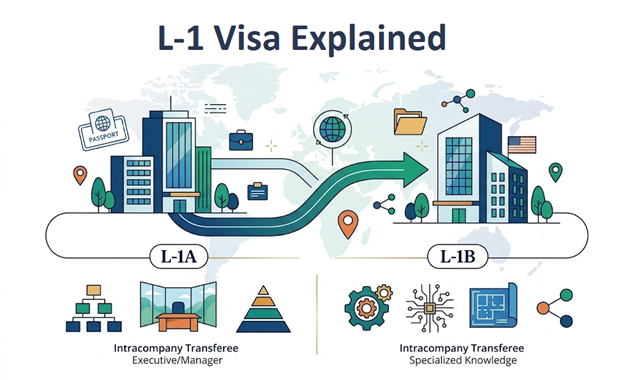
The L-1 visa is the preferred choice for global companies that are accelerating their US expansion. In fact, in the first half of 2025, L-1A petition filings increased to 12,733 compared to 10,897 in 2024, according to Maynard Nexsen Analysis.
An L1 visa is a temporary non-immigrant visa that makes it easy for business owners to transfer employees to their US office temporarily.
If you’re wondering whether you qualify for an L-1 visa and how to apply, this article explains everything you need to know. You’ll learn about its eligibility rules, required documents, application steps, and more.
What is an L-1 Visa in the USA?
The L-1 is an intracompany transfer visa that allows multinational businesses to move employees from an office outside the United States to a related office in the US for a temporary assignment. The employees can be managers, executives, and workers with specialized knowledge or exceptional ability in their job.
L1A vs L1B: The Types of L-1 Visa Explained
The L-1 visa has two categories: the L1A visa and the L1B visa. The L-1A visa is for managers and executives who are being transferred to a company office in the United States. Meanwhile, the L-1B visa is for employees who have specialized knowledge of the company’s products, services, systems, or internal processes.
These two visa types differ in duration of stay and the path to a green card. The following table shows the main difference between L1A and L1B types.
Feature | L-1A Visa | L-1B Visa |
Who qualifies | Managers & executives | Specialized knowledge employees |
Initial validity | 3 years (1 year for new offices) | 3 years (1 year for new offices) |
Duration of stay | 7 years | 5 years |
Green card path | Direct EB-1C eligibility | Via PERM or EB-1C if promoted |
L1 Visa Requirements for Business Owners and Workers
Both the employee being transferred and the sponsoring U.S. company must meet separate L-1 visa requirements. Below are the L1 visa eligibility rules for each.

Employee Requirements:
According to the USCIS, an employee must meet the following criteria for the US transfer.
- One-year employment rule: The employee must have worked for the foreign company continuously for at least one full year during the three years before the transfer to the United States.
- Qualified job position: For an L-1A visa, the employee must work in a real executive or managerial role. For an L-1B visa, the employee must have specialized knowledge that is advanced, company-specific, and not commonly found in the industry.
- Qualified company relationship: The transfer must be between related companies, such as a parent company, subsidiary, affiliate, or branch office.
Employer Requirements:
To transfer a worker to their US office, a business owner must align with the following rules.
- Active U.S. business operations: The U.S. company must be actively doing business in the United States and must have a real physical office or workspace.
- Proof of company relationship: The ownership and control relationship between the foreign company and the U.S. company must be supported with clear records.
- New office requirement: If the U.S. office has been operating for less than one year, the company must provide a realistic business plan and proof that it has enough money to operate.
Key Documents Required for the L-1 Visa Application
A complete L-1 visa application needs documents from both the employer and the employee being transferred. If your application includes unclear or incomplete documents, USCIS may send a Request for Evidence (RFE).
To avoid this, an employer must include the following documents in the application.
- Form I-129: The main petition form to request L-1 visa classification.
- Support letter: Explains the employee’s position, duties, qualifications, and the business reason for the transfer.
- Proof of company relationship: Documents showing the U.S. and foreign companies are related, such as ownership records, organization charts, and financial statements.
- For a new U.S. office: A business plan, signed office lease, and financial projections.
Similarly, employee documents must include the following.
- Proof of one continuous year of foreign employment: Includes offer letters, pay records, or tax documents.
- Proof of job duties: Evidence that the employee worked in a managerial, executive, or specialized knowledge role.
- Valid passport: Must be current and valid for travel.
- Form DS-160: If applying at a U.S. embassy or consulate outside the United States.
L1 Visa Process: Application Steps and Processing Times
If you’re wondering how to get an L-1 visa, be aware that the process is started and managed by a U.S. employer. So, the U.S. company you want to transfer to must file the petition for your case.
That said, here are quick steps for the L1 visa application process.
- Employer files Form I-129 with USCIS.
- USCIS adjudicates the petition.
- Apply for a visa stamp (if outside the US).
- Enter the US and begin work.
L1 Visa Processing Time
The L1 visa timeline depends largely on the processing option you choose. Standard processing runs usually 2 to 6 months. Meanwhile, if you choose premium processing, you can obtain a decision within 15 business days. As of March 2026, the premium processing fee for an L1 visa is $2,965, according to USCIS data. And it is the preferred choice for organizations that need to transfer an employee quickly.
Key L1 Visa Benefits for Business Owners
In addition to helping companies transfer employees, the L-1 visa offers several important advantages for business owners. Let’s review these.
- No Yearly Limit. Unlike the H-1B visa, which has a yearly cap of 85,000 visas and uses a lottery system, the L-1 visa has no annual limit. This makes it one of the easiest visas to get for the USA, as you can apply at any time during the year.
- Dual Intent. The L-1 visa dual intent means a person can hold a temporary visa status while also applying for a green card. This means the visa holder can seek permanent residence in the United States without harming their current L-1 status.
- L1 Visa Work Authorization for Spouse. The spouse of an L-1 visa holder can enter the United States on an L-2 visa. The spouse is authorized to work incident to status, which means a separate Employment Authorization Document (EAD) is no longer required.
- L1 Visa to Green Card Timeline. L-1A visa holders can apply for an EB-1C green card without needing PERM labor certification, which often makes the process faster than many other employment-based green card options. Meanwhile, L-1B visa holders need to apply through the PERM process.
Final Words
The L1 visa is one of the most practical and business-friendly options for multinational companies that want to start or expand operations in the United States. It offers important benefits, especially through the L-1A category, that many other work visas do not offer.
That said, a successful outcome depends heavily on how well the petition is prepared and presented. If you are considering an intracompany transfer to the US, getting the right legal counsel early can save you significant time, cost, and stress down the line.
At Toure-Hernandez & Associates, P.C., our highly experienced immigration attorneys can help you at every stage of the process. Our team will review your eligibility, prepare your petition, and build the strongest possible case for your application. Get in touch today!