What’s the Easiest Visa to Get for the U.S.?
March 25, 2026
The US hosted 1,177,766 international students in 2024 to 2025, which is 5% more than the previous year, according to the IIE Open Doors 2025 Report.
These International students contribute nearly $42.9 billion to the U.S. economy and support more than 355,000 jobs across the country, according to NAFSA data.
If you are applying to a US school or college, it is important to understand the current student visa USA requirements. Several major changes have been introduced this year, including mandatory in-person interviews and updated fee structures.
This guide explains the key details you need, including eligibility criteria, application costs, processing times, and other essential information.
Which US Student Visa to Apply For?
The USA offers three main student visa options. The most common one is the F-1 visa. If you’re planning to study at an SEVP-certified college, university, or language institute, this is the route you will need to take. In addition to the F-1, there are the M-1 and J-1 visas. M-1 is for vocational or non-academic programs. Meanwhile, the J-1 visa is for exchange programs.
For most of you aiming for a full academic degree, the F-1 visa will be the main focus.
The F-1 Student Visa Requirements in 2026
In 2026, there are several rules you’ll need to consider when applying for an F-1 student visa. Below are several F-1 US student visa requirements for your application to be approved.
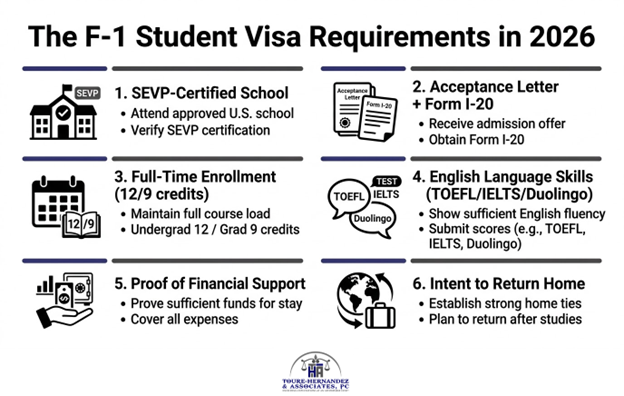
Let’s review these requirements in detail.
SEVP-Certified School
The school you’re applying to must be approved by the Student and Exchange Visitor Program (SEVP). This is because only some approved schools are allowed to issue the required Form I-20. And without this form, you cannot apply for an F-1 visa.
Acceptance Letter and Form I-20
You must have an official acceptance letter from your school and a completed Form I-20 (Certificate of Eligibility). The I-20 will include your details, such as your program, how long it will last, and the estimated cost of your education.
Full-Time Enrollment:
You are required to study full-time during each academic term. This usually means at least 12 credit hours per semester for undergraduate students and at least 9 credit hours per semester for graduate students.
English Language Skills
When applying for a student visa, you will also need to prove your English language skills. To do this, you’ll need to meet the minimum English test scores as required by your school. Some accepted tests are TOEFL, IELTS, or the Duolingo English Test.
Proof of Financial Support
USA student visa financial requirements include showing clear evidence that you can pay for your tuition and living expenses while in the US. You can show your financial ability using documents such as:
- Recent bank statements
- Official scholarship or funding letters
- Affidavits of support from sponsors (such as parents or relatives)
- Approved student or education loan documents
It’s important that you avoid making large cash deposits shortly before your visa interview if you cannot clearly explain their source. Visa officers will strongly scrutinize these deposits and may see them as a concern.
Intent to Return Home:
You must also prove that you plan on returning to your home country after completing your studies. To do this, you will typically need to show strong connections with your family, or that you own a property, or have plans for future jobs in your country.
In-Person Visa Interview
After the September 2025 updates, most non-immigrant visa applicants, like those applying for F-1 student visas, are required to attend an in-person interview in the presence of a consulate officer.
How to Get a Student Visa for the USA: Step-by-Step Process
Now that you know the core student visa USA requirements, let’s review the application process for an F-1 visa. Follow the step-by-step guide below to get started easily.
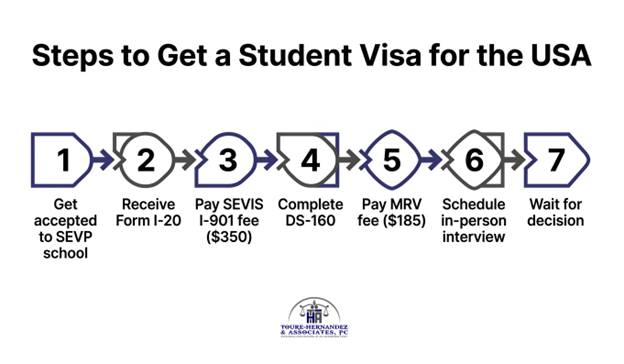
Step 1. Get accepted to a school
To start your application process, you must be accepted by a USA school that is certified by the SEVP.
Step 2. Receive your Form I-20:
After you are accepted, your school will issue your Form I-20. The form will include the date when your program will end and how much it might cost for one year.
Step 3. Pay the SEVIS I-901 fee:
If you are applying for an F-1 visa, you must pay a $350 fee (updated 2026 rate). Once submitted, keep the payment receipt, because you will need to show it at your visa interview.
Step 4. Complete the DS-160 application:
Fill out and submit the DS-160 form online via the U.S. Department of State visa website. You will need your Form I-20, a valid passport, your travel history, a passport-style photo, and your CV. After you submit the form, save and print the confirmation page with the barcode.
Step 5. Pay the MRV fee:
Once done with documentation, you can pay the $185 visa application fee. This will allow you to apply for your interview.
Step 6. Schedule your interview:
Book your in-person interview at the U.S. embassy or consulate. You’ll need to bring all your original documents with you. Also, your fingerprints will be taken during the visit.
Step 7. Wait for your visa decision:
In most cases, you will receive a decision at the end of your interview. Some applications require additional review, called administrative processing. In this case, the embassy or consulate will contact you for further instructions.
For information about other types of US visas, see our breakdown of the easiest US visa to get.
New Student Visa USA Cost in 2026
After the launch of the 2026 “Beautiful Act” immigration package, the standard student visa USA cost has been updated to include the Visa Integrity Fee of $250. This is included to support stronger security checks and background screening required by the new regulations.
So, including the SEVIS I-901 and MRV fees, you may need to pay an estimated sum of $535 to $785. But the exact cost for an F-1 visa can change based on any local fees in your country, such as reciprocity or visa issuance fees. You can check about any applicable issuance fees from the US Department of State’s website.
Student Visa USA Processing Time and Duration of Stay
Once you receive your I-20, you can expect the U.S. student visa process to take about 30 to 45 days. Moreover, processing times can stretch out worldwide during the peak season between May and August. So, the smart move is to start your application process early. Aim for at least 3 to 4 months before your program begins.
Once approved, your F-1 student visa USA duration will be for the fixed term of your program’s period, unlike the previous flexibility of ‘Duration of Stay.’ Once your program ends, you can stay for a maximum of 60 days (the grace period for leaving the U.S. or changing status is expected to be reduced from 60 days to 30 days), after which you must depart from the US.
Summing Up The Student Visa USA Requirements
The student visa USA requirements in 2026 have been updated to include in-person interviews and an additional Visa Integrity Fee. You’ll need to meet all the latest requirements for your application to be accepted. Make sure to start early and stay updated with new policy updates.
Personalized legal support during this process can make all the difference in the approval of your application. At Toure-Hernandez & Associates, P.C., we help students with their student visa applications, maintaining visa status, and meeting all U.S. immigration requirements. Contact us now to navigate this process with l